
Commercial Boiler Care
Commercial Boiler Service & Repair in New Bern, NC
GP Heating & Cooling is a family-owned and locally-owned company based in New Bern, NC. Our commercial team services and repairs boilers for businesses that rely on dependable heat through the cold months. We maintain and repair the boilers already in place at your property, and we do not install or replace boilers. Every visit starts with the safety devices, controls, burner and circulation system, followed by a plain-language explanation of what we found. Backed by 22 years of experience, we recommend only the repairs your equipment needs.
Why Our Approach Differs
What a Boiler Company Should Do Before Touching Your System
A boiler holds a building’s heat through its coldest weeks, so the way we approach the work matters as much as the repair itself. These six commitments guide every boiler call we take.
A family owner who stays accountable for the outcome
Our company is family-owned, which means the people who schedule your visit are the same people who answer for the result. A boiler can serve a building for many years, and that long relationship depends on a company that stands behind its diagnosis. Our About Us page describes our background in more detail.
Safety devices tested before performance
We check the low-water cutoff, pressure relief valve, high-limit controls and flame-failure devices before we look at comfort complaints. A boiler that delivers heat but fails a safety test is not ready to return to service, and we will say so plainly.
Repairs ranked by what the building needs
Items that affect safety or heat delivery come first, while improvements that only lift efficiency can be scheduled into a later window. You decide the sequence with full information, and we never bundle optional work into a required repair.
Records your maintenance staff can use
Each visit produces a written test record listing readings, parts touched and open recommendations. Staff can share those notes with ownership or an outside engineer without needing to interpret technical shorthand.
Shutdown windows planned around occupancy
Boiler work can take heat away from an entire wing, so we agree on timing, access and tenant notice before the job starts. When testing requires a temporary shutdown, we confirm when heat will return and keep the people on site informed.
Community values in every commercial account
We sponsor a local Christian school and a Sunday School recreation league, and those commitments shape how we treat commercial customers. The businesses we serve in New Bern and nearby communities are our neighbors, and they receive the same candid diagnosis we give family homes.
Send Us the Details
Tell Us What Your Boiler Is Doing
Describe the symptoms, the age of the boiler if you know it, and the areas of the building that are not heating properly, then send those details through our contact page. Our technicians come to your property to test the equipment where it runs, so nothing needs to be moved or shipped away. If a boiler problem points toward a larger issue, we will explain it plainly. Our chiller service and repair page, our rooftop unit repair and maintenance page and our commercial HVAC overview describe the other commercial systems we service.
Pressure Drops or Frequent Make-Up Water
A boiler that loses pressure over a few days, or needs water added again and again, may have a leak, a faulty fill valve or a failing relief valve. Repeated make-up water also brings fresh oxygen into the system, which speeds corrosion inside the boiler and piping. We pressure-test the system, check the fill valve and search for hidden leaks before recommending a fix.
Banging, Knocking or Gurgling in the Pipes
Noise from the piping often signals trapped air, water hammer, sediment build-up or a circulator working against a restriction. Left alone, these conditions can damage fittings and reduce heat delivery to the rooms farthest from the boiler. We listen for the pattern, check venting and circulation, and tell you whether the sound points to a simple adjustment or a larger repair.
Uneven Heat Across the Building
When one zone never reaches its setpoint while others run warm, the cause may be a stuck zone valve, a weak circulator, air in a loop or a balancing problem. Managers often notice this first in offices at the far end of a loop or in rooms with limited radiation. We check flow and temperature on each accessible loop and record where the heat falls short.
Burner Flicker, Delayed Ignition or Repeated Lockouts
A burner that takes several tries to light, flickers during operation or keeps locking out is telling you something about the flame sensor, igniter, gas pressure or venting. Repeated resets can hide the fault without fixing it. We review the lockout history, test ignition and flame signal, and confirm that the burner is combusting cleanly.
Soot, Scorch Marks or a Gas Odor
Soot around the boiler, scorch marks on the jacket or a gas smell are reasons to stop and act. If you smell gas, leave the building, avoid operating switches and contact your gas utility from outside. Call us once the area is safe, and we will test combustion, heat exchanger condition and venting before returning the boiler to service.
Water Leaks Around the Boiler or Piping
Drips at fittings, wet floors beneath the boiler or staining on the jacket can indicate a failing gasket, a weeping valve, a corroded section of pipe or a leaking expansion tank. Small leaks tend to grow as pressure and temperature cycle. We isolate the source, document its location and recommend the repair that addresses the cause rather than the symptom.
How We Service Your Boiler
The Sequence We Follow on Every Boiler Call
Each visit follows a fixed order. Safety items come before comfort complaints, and building staff receive a record of every test we performed.
Step 1 of 5
Gather the Operating History
We start with what your staff has observed before anyone opens the boiler room door.
- Record the boiler make, model and approximate age from the nameplate.
- Ask when the problem began and whether it follows a schedule, a zone or a load.
- Collect past service notes, repair records and any changes made to the piping or controls.
- Confirm the operating setpoints, reset schedule and the person responsible for adjusting them.
- Agree on shutdown windows and the areas that will lose heat during testing.
Step 2 of 5
Verify the Safety Devices
Safety devices come first, and we confirm each one before testing performance.
- Test the low-water cutoff and confirm that it trips and resets as designed.
- Check the pressure relief valve for seepage, corrosion and correct discharge piping.
- Verify high-limit and operating controls against the setpoints the system is meant to hold.
- Inspect flame sensors and flame-failure devices for proper response.
- Confirm that the gas shutoff valves close and reopen without sticking.
Step 3 of 5
Inspect the Burner, Ignition and Gas Section
Gas-fired boilers depend on clean combustion and a steady, correctly regulated gas supply.
- Inspect burner ports, igniters and flame patterns for wear and build-up.
- Measure gas pressure at the valve train and compare it with the boiler’s specifications.
- Read combustion levels and compare them with the manufacturer’s combustion targets.
- Check the gas valve, regulator and vent connections for leaks or damage.
- Note any gas line concerns and whether our commercial gas line team should review them.
Step 4 of 5
Test Water Flow, Pumps and Heat Delivery
Heat only reaches the building if water or steam moves through the system as designed.
- Check circulator pumps for proper operation, amperage draw and noise.
- Measure supply and return temperatures at the boiler and at each loop we can reach.
- Inspect expansion tanks, fill valves and system pressure.
- Look for trapped air, sediment in strainers and restrictions in the piping.
- Confirm that zone valves and thermostats call for heat in the correct sequence.
Step 5 of 5
Deliver the Written Record and Next Steps
The visit closes with a written test record, so every repair decision rests on measured data.
- List each test performed, along with the readings recorded.
- Separate required repairs from recommended improvements, with the reason for each.
- Note the parts we replaced, adjusted or cleaned, so future technicians can trace the work.
- Recommend a planned visit interval and the items to watch between visits.
- Explain how a planned visit under our commercial maintenance plan keeps the boiler on a set calendar.
Common Boiler Repairs
Parts and Systems on a Boiler We Repair
Burner Assembly and Igniters
Worn igniters, dirty burner ports and misaligned flame patterns reduce efficiency and can cause lockouts. We clean and test the burner assembly, replace components that no longer ignite reliably and confirm a stable flame.
Flame Sensors and Safety Controls
A dirty or failing flame sensor can shut the burner down even when the flame is present. We clean and test sensors, verify flame-failure response and replace controls that no longer trip as designed.
Circulator Pumps and Motors
Noisy or failing circulators can leave loops cold while the boiler runs. We check amperage draw, bearings and impellers, then repair or replace the pump to restore flow.
Pressure Relief and Fill Valves
Relief valves that weep and fill valves that let water creep in both waste water and stress the system. We test relief valves, clear discharge piping where access allows and replace valves that no longer hold.
Expansion Tanks and System Pressure
A waterlogged or undersized expansion tank lets system pressure swing with temperature. We check tank pressure, confirm the air charge and recommend the repair that keeps pressure steady.
Gas Valves, Regulators and Venting
Gas valves that drift and vent connections that have corroded are both safety concerns. We test valve operation, check regulator settings and inspect vent connections for leaks or blockage.
Zone Valves and Thermostat Controls
Stuck zone valves and miscalibrated thermostats send heat to the wrong places. We test each valve’s travel, verify thermostat signals and correct the sequence that calls for heat.
Common Questions
Common Questions About Commercial Boiler Service
No. Our commercial boiler work covers service and repair of boilers already in place at your property, and we do not install or replace them. If your building needs new rooftop heating and cooling equipment, our rooftop unit installation page explains that service. When a boiler has reached the point where repair no longer makes sense, we will tell you so directly, with the test readings that support the recommendation.
We test the low-water cutoff, pressure relief valve, high-limit controls, flame-failure devices and gas shutoff valves on every visit. Each device is checked for proper response, and we note any that fail to trip, reset or seal as designed. Safety items come first, so we confirm the protective chain works before we look at heat delivery or efficiency. Any failed device is listed in the written record with its location and needed repair.
Repeated pressure loss usually points to a leak, a weeping relief valve, a fill valve that no longer seals or a failing expansion tank. Some leaks hide inside walls, under insulation or at buried fittings, so pressure can drop with no visible water. We test the system to isolate the source, then recommend a repair that addresses the cause. Adding water over and over without finding the leak wastes water and stresses the boiler.
In many cases, yes. Most service work can be planned around occupied hours, although some testing requires a temporary shutdown of heat to a wing or zone. We agree on timing, access and tenant notice before the visit begins, and we confirm when heat will return. Where a repair needs an extended outage, we explain the schedule in writing so managers can plan around it and keep people informed.
Check whether the problem affects the whole building or one zone, and note any alarm lights, unusual sounds or water on the floor. If you smell gas, leave the building and contact your gas utility from outside. Do not repeatedly reset a boiler that keeps locking out, since resets can hide the cause. Write down what you observed, then reach out through our contact page so the technician can review those details first.
Combustion testing measures how completely the burner uses fuel and whether flue gases leave the building as designed. Drifting readings can point to dirty burners, poor combustion air, a failing gas valve or restricted venting. Testing before and after a repair confirms the fix changed what it was meant to change. Because combustion problems affect safety as well as efficiency, we record the readings and explain them in plain language.
The right interval depends on the boiler’s age, its operating hours, the conditions in the water or steam system and what the first inspection finds. We set the interval after reviewing the test record rather than applying one schedule to every building. Many commercial customers prefer planned visits before the heating season, and we list the components to watch between visits. Planned service keeps inspections on a predictable calendar.
Yes. Service Finance is available for qualifying projects, so a larger repair can be spread across monthly payments rather than paid as one amount. Financing suits repairs that involve several components or a larger scope of work, and it is worth discussing early in the process. We present the financing option alongside the written findings, so you can decide with the full picture before approving any work.
Uneven heat usually means water or steam is not reaching every loop in the amount the design requires. The cause may be trapped air, a sticking zone valve, a weak circulator, a piping restriction or a balancing problem that sends most of the flow to nearby loops. We measure supply and return temperatures on each accessible loop, so the repair targets the restriction rather than adding heat at the boiler.
Our commercial boiler service reaches Havelock, Morehead City, Trenton, Jacksonville and Kinston, and our office is in New Bern. Each property receives the same inspection sequence regardless of location. If your building sits outside these communities, reach out through the contact page and we will confirm whether we can serve the property before you schedule a visit.
Service Communities
Five Communities Served by Our Boiler Team
Boiler service and repair visits reach these North Carolina communities from our New Bern office. For a broader view of our coverage, see our service area overview.
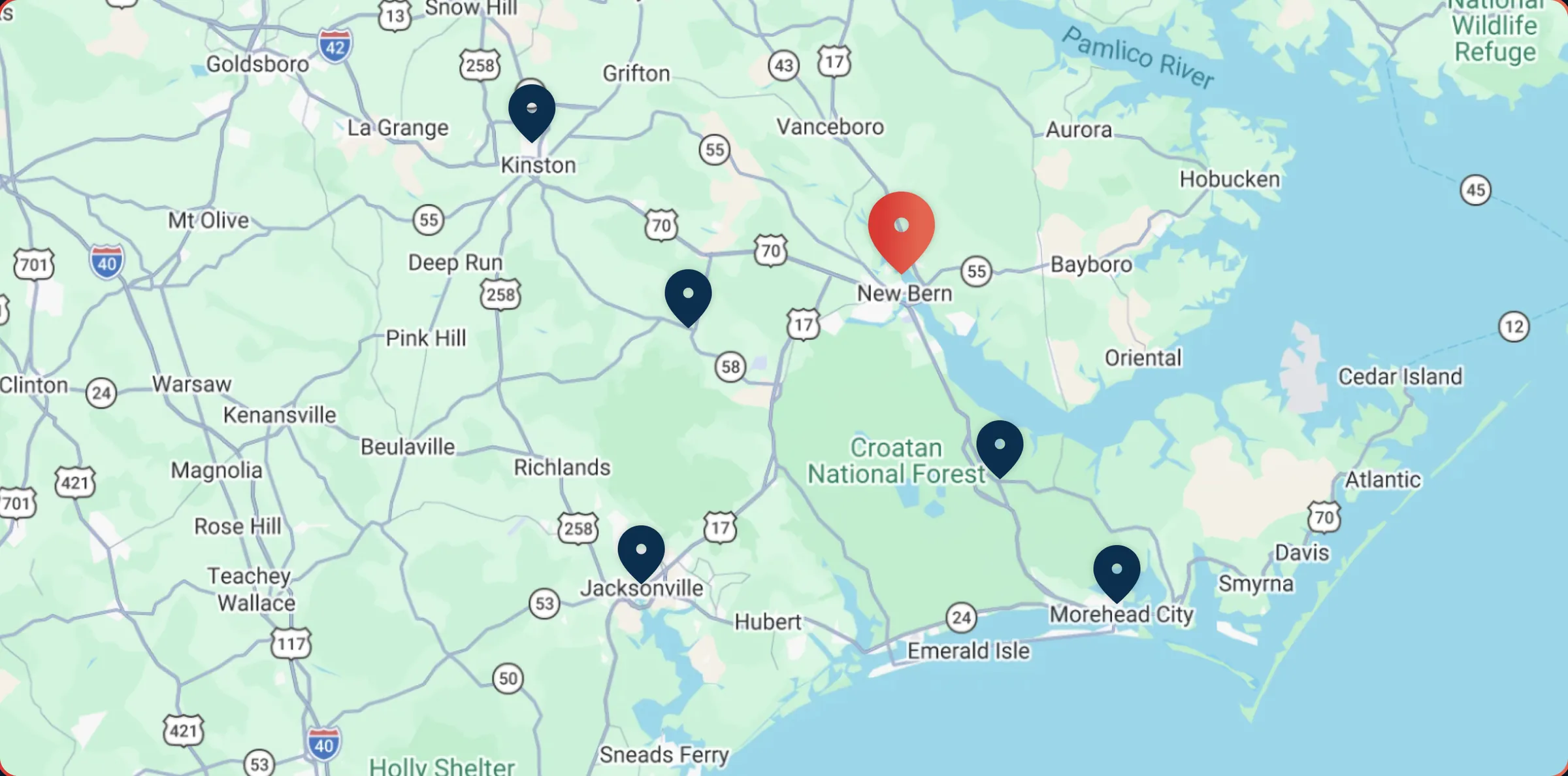
- New Bern, NC
- Morehead City, NC
- Jacksonville, NC
- Havelock, NC
- Trenton, NC
- Kinston, NC

Additional Communities Served
Don’t see your town listed? We regularly help customers in nearby communities throughout the region. Give us a call and we’ll let you know if we can reach you.
Related Building Work
Where Boiler Care Connects to the Rest of Your Building
Heating equipment shares space, piping and controls with other systems, so these related services are worth comparing as your building’s needs become clearer.
Commercial gas line services
Gas piping work for commercial properties, including supply lines that feed boilers and other heating equipment.
Learn More about Commercial gas line servicesResidential gas line services
Gas line work for homes, from supply lines to appliance connections.
Learn More about Residential gas line servicesCustom sheet metal fabrication
Custom-fitted sheet metal pieces for repairs and installations that need a precise fit.
Learn More about Custom sheet metal fabricationIndoor air quality solutions
Filtration, UV lighting and humidity control for occupied spaces.
Learn More about Indoor air quality solutions
Plan Your Next Step
Your New Bern Commercial Boiler Contractor
A boiler that runs well keeps a building comfortable through the coldest weeks of the year, while a boiler that quietly loses ground can turn a small fault into a costly shutdown. Tell us what the system is doing, where the heat falls short and what your staff has noticed, and our team will review the equipment on site. A repair decision should rest on measured data. We explain the test readings behind each recommendation, separate required items from improvements that can wait, and offer only the work that supports how your building is used.
Service Finance is available for qualifying projects, so a larger repair can be planned around monthly payments rather than absorbed as a single expense. Our financing page outlines how the program fits into a commercial budget. Between repairs, planned care keeps the safety devices, burner and circulation system on a predictable schedule, and our commercial maintenance plan is built for that purpose. Ask about the plan when you call, and we will explain how it applies to your property.
Whether your property sits in New Bern or in one of the five communities we serve, our team welcomes questions about boiler testing, repair decisions and planned care. Our crews work with building managers, owners and maintenance staff alike, so the findings reach the people who must approve the work. You can also review our full range of services to see how boiler service fits alongside the heating, cooling and gas line work we handle. When you are ready, reach out and we will explain what we find before recommending anything.